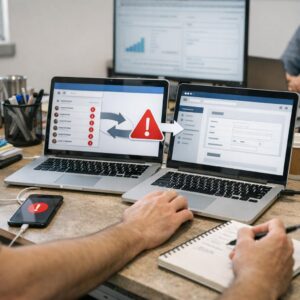
What if your “successful” conference booth is quietly costing 3x more per customer than your best paid channel?
Booth traffic, badge scans, and packed demo slots can make sponsorship feel like momentum-but none of those metrics prove the event was profitable.
To calculate the true CPA of a sponsored conference booth, you need to go beyond the invoice and include travel, staffing, production, follow-up time, opportunity cost, and the conversion lag from lead to closed customer.
This article breaks down how to measure the real cost per acquisition so you can decide which events deserve more budget, which need renegotiation, and which should be cut entirely.
What True CPA Means for Sponsored Conference Booths-and Why Badge Scans Are Not Enough
True CPA for a sponsored conference booth is not the cost per badge scan. It is the total event investment divided by the number of real customers acquired from that event, after filtering out unqualified leads, stalled sales conversations, and contacts who never had buying intent.
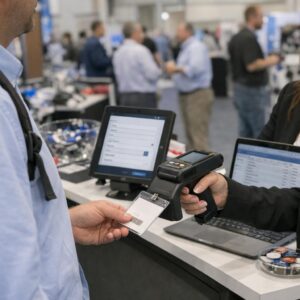
Badge scans are useful for lead capture, but they often create a false sense of performance. A booth may collect 400 scans, yet only 35 may match your ideal customer profile, 12 may enter the sales pipeline, and 3 may eventually become paying customers. That final number is what matters for customer acquisition cost, revenue attribution, and marketing ROI.
To calculate true CPA, include more than the booth sponsorship fee. Factor in:
- Booth rental, design, shipping, devices, Wi-Fi, and event management software
- Travel, hotels, meals, staff time, and sales follow-up costs
- Promotional giveaways, paid meeting tools, CRM cleanup, and post-event campaigns
In practice, I’ve seen teams celebrate a packed booth, then discover in Salesforce that most scans were students, vendors, competitors, or people only interested in the giveaway. A better approach is to tag every lead by source, qualify them in the CRM, and track movement from scan to meeting, opportunity, closed deal, and retained customer.
The benefit is clarity. When you measure true CPA, you can compare sponsored conferences against Google Ads, LinkedIn Ads, webinars, account-based marketing, or partner campaigns using the same financial lens. Badge scans show activity; true CPA shows whether the booth actually helped the business grow.
How to Calculate Booth CPA Using Total Event Costs, Lead Quality, and Sales Conversion Data
To calculate the true booth CPA, start with the full event investment, not just the sponsorship fee. Include booth rental, exhibit design, travel, hotel, shipping, lead retrieval software, sales collateral, paid ads promoting your attendance, and staff time.
The basic formula is simple: Total Event Cost ÷ Number of New Customers Acquired = Booth CPA. The mistake I often see is counting every badge scan as a “lead,” when many are students, vendors, competitors, or low-fit contacts who will never enter a real sales pipeline.
- Total event cost: all fixed and variable expenses tied to the conference booth
- Qualified leads: contacts that match your ICP, budget range, and buying timeline
- Customers acquired: closed-won deals directly influenced by the booth
For example, if your company spends $42,000 on a sponsored booth and captures 300 scans, the booth may look efficient at first. But if only 90 are qualified leads, 18 become sales opportunities, and 6 convert into paying customers, your real CPA is $7,000, not $140 per scan.
Use a CRM like Salesforce or HubSpot to tag every contact with the campaign source, lead score, opportunity stage, and close date. This helps separate high-intent buyers from casual booth traffic and gives finance, marketing, and sales one reliable view of customer acquisition cost.
A practical tip: compare booth CPA against customer lifetime value, average contract value, and your normal digital marketing CPA. A higher conference CPA can still be profitable if the event produces larger enterprise deals, shorter sales cycles, or stronger account-based marketing opportunities.
How to Lower Conference Booth CPA by Optimizing Sponsorship Level, Follow-Up Speed, and Pipeline Attribution
Lowering conference booth CPA starts before you buy the sponsorship package. Many teams overpay for premium placement, keynote branding, or lounge sponsorships without checking whether those benefits create qualified sales pipeline. A practical approach is to compare booth traffic quality, meeting volume, and closed-won revenue from past events against each sponsorship level, not just badge scans.
For example, a B2B software company may find that a mid-tier booth plus a private meeting room produces better CPA than a platinum sponsorship with broad logo exposure. The reason is simple: high-intent demos and scheduled account-based marketing meetings usually convert better than casual expo hall conversations. In my experience, the biggest waste often comes from paying for visibility that sales cannot convert quickly.
- Choose sponsorship by pipeline goal: If the goal is enterprise lead generation, prioritize meeting access, attendee data rights, and speaking opportunities over booth size.
- Speed up follow-up: Use HubSpot, Salesforce, or Marketo to route scanned leads instantly, trigger personalized emails, and assign sales reps before interest cools.
- Track true attribution: Tag every lead source with event name, booth campaign, sponsorship tier, and follow-up sequence so CRM reporting shows real customer acquisition cost.
Follow-up speed is especially important. A lead scanned on Tuesday should not wait until the next Monday for a generic email. Use mobile lead capture, calendar booking links, and segmented sales sequences to move prospects into demos while the conversation is still fresh.
Finally, review CPA by opportunity stage, not only lead count. If a lower-cost sponsorship creates fewer leads but more qualified pipeline, it may be the better investment for future conference marketing budgets.
Final Thoughts on Calculating the True Cost Per Acquisition (CPA) for Sponsored Conference Booths
True booth CPA is a decision tool, not just a post-event metric. When every cost is included and every qualified outcome is tracked, sponsorship value becomes easier to compare against digital campaigns, partner programs, and alternative events.
The practical takeaway is simple: do not judge a booth by badge scans or foot traffic alone. Judge it by pipeline quality, sales conversion, customer fit, and total investment. If the fully loaded CPA supports your margin goals and produces relationships your other channels cannot, the booth deserves consideration. If not, renegotiate, redesign the strategy, or skip the event.

Dr. Lucas Harrington is a technology and business events specialist focused on virtual conferences, hybrid event solutions, and professional networking platforms. He provides practical guidance for companies adapting to the future of digital events.